

Family life is filled with moments of joy, stress, routine, and unpredictability. In the midst of busy schedules and occasional conflict, one powerful yet often overlooked tool can transform how families connect: gratitude. Research shows that gratitude isn’t just about saying “thank you,” it’s about noticing, appreciating, and responding to the efforts and care of others. When gratitude becomes a regular practice in the family system, it can significantly enhance relational satisfaction and overall wellbeing.

But how can we show gratitude within our daily lives? There are practical, research-informed ways families can use gratitude to strengthen their relationships.
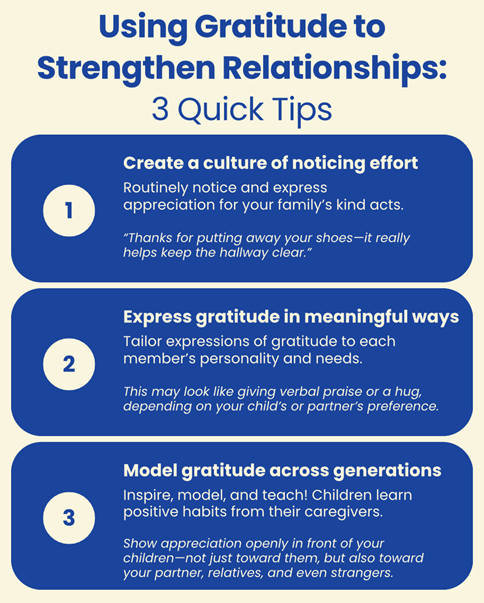
1. Create a Culture of Noticing Effort
The Find-Remind-and-Bind Theory[1] suggests that gratitude helps us notice the good in others, reminds us of our social bonds, and binds us more closely together. In families, this means paying attention to the small acts of care that often go unnoticed, such as a sibling sharing toys, a partner cooking dinner, or a child helping with chores.
Practical Tip:
Make it a habit to point out and thank family members for their contributions, no matter how small. For example, “Thanks for putting away your shoes—it really helps keep the hallway clear.” These acknowledgments build a cycle of appreciation rather than expectation, and they reinforce the specific character traits that we all want to develop in each other, such as self-discipline, thoughtfulness, and kindness.
2. Express Gratitude in Meaningful Ways
The Perceived Partner Responsiveness[2] framework highlights that gratitude deepens connection when it feels genuine and personal. In families, this translates to expressing appreciation in ways that match each member’s personality and needs.
Practical Tip:
Some children may respond to verbal praise, while others may feel more valued through a hug or a note in their lunchbox.
3. Model Gratitude Across Generations
Children often learn more from how we live than from what we say. In our virtues-based EFFT work, we remind parents to inspire, model, and teach. Gratitude is a powerful example of this in action.
When parents or caregivers consistently express gratitude, they are modelling a core relational virtue. This doesn’t just shape children’s behaviour in the moment, it inspires them and teaches them how healthy relationships function.
Practical Tip:
Show appreciation openly in front of your children, not just toward them, but also toward your partner, relatives, and even strangers. Over time, gratitude becomes woven into the family’s identity and value system.
For parents who want to explore this virtues-based approach more deeply, the Virtues Project offers excellent resources on cultivating character and relational strengths in families. You can learn more at virtuesproject.com.
[1] Algoe, S. B. (2012). Find, Remind, and Bind: The Functions of Gratitude in Everyday Relationships. Social & Personality Psychology Compass, 6(6), 455–469. https://doi.org/10.1111/j.1751-9004.2012.00439.x
[2] Jolink, T. A., Chang, Y.-P., & Algoe, S. B. (2022). Perceived Partner Responsiveness Forecasts Behavioral Intimacy as Measured by Affectionate Touch. Personality and Social Psychology Bulletin, 48(2), 203–221. https://doi.org/10.1177/0146167221993349